
Picking an AI coding assistant for GraphQL API development in 2026 means choosing between tools that autocomplete code inside your editor and tools that generate the schema, resolvers, and data models from a specification before you write a line of GraphQL by hand.
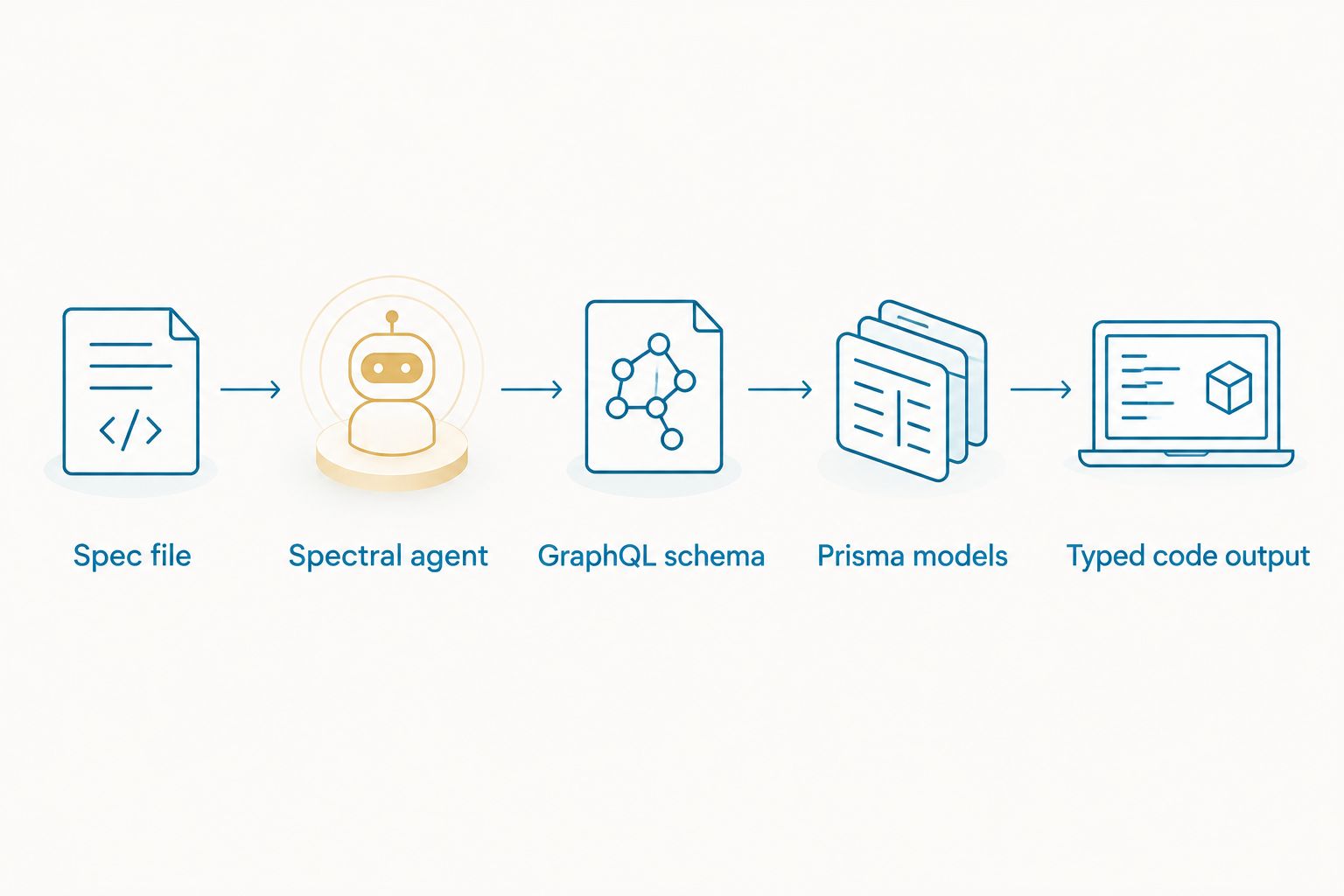
- Aexol's Spectral agent generates GraphQL schemas, resolvers, and Prisma models directly from a spec file, skipping manual schema writing entirely.
- GitHub Copilot wins for teams who want inline suggestions inside an existing IDE, not full-schema generation.
- Amazon Q Developer is the pick for GraphQL APIs built on AWS AppSync.
- Tabnine fits enterprise teams that need on-prem or private model deployment for compliance.
- Cursor and Windsurf both handle large-codebase refactors but neither generates a GraphQL schema from a specification.
Why this matters
GraphQL API development in 2026 has a schema problem most coding assistants don't solve: they complete the code you're already writing, they don't generate the schema, resolvers, and type-safe models from a specification. A resolver written by an autocomplete tool still needs someone to hand-write the SDL, the Prisma model, and the client types that match it. Aexol built its Spectral coding agent specifically to close that gap: describe the API in a specification language and the agent produces the schema plus production-ready TypeScript, Python, Rust, or Go code, including the Prisma models, in one pass. A coding assistant that can't generate the schema is just autocomplete with a better model behind it. That's a different job than what Copilot, Cursor, or Windsurf do, and picking the wrong category of tool for GraphQL work wastes the multi-file, multi-language part of the job that's actually slow.
What makes the best AI coding assistant for GraphQL API development
- Schema-first generation — produces valid GraphQL SDL and resolvers from a spec, not just line completions
- Multi-language output — emits type-safe code in more than one target language (TypeScript, Python, Rust, Go) from the same source
- Data-model consistency — keeps Prisma or ORM models in sync with the schema automatically
- Cross-session memory — recalls earlier project decisions without re-explaining context every session
- Context efficiency on large tasks — handles big multi-turn sessions without blowing through token budgets
- IDE or CLI fit — works inside the workflow the team already has
At a glance: AI coding assistants for GraphQL API development in 2026
| Tool | Best for | Standout feature | Key limitation |
|---|---|---|---|
| Aexol Spectral | Spec-to-schema GraphQL generation | Generates schema, resolvers, and Prisma models from one spec file | Requires learning the specification language first |
| GitHub Copilot | Inline completion inside existing IDE workflows | Fast line-by-line suggestions in VS Code, JetBrains, Neovim | Doesn't generate a GraphQL schema or data model on its own |
| Amazon Q Developer | AWS AppSync-based GraphQL stacks | Native awareness of AWS services and IAM in suggestions | Weak outside the AWS ecosystem |
| Tabnine | Privacy-first enterprise deployment | Can run on private infrastructure or self-hosted models | Less capable at generating full multi-file schemas |
| Cursor | Large-codebase agentic refactors | AI-native IDE built for multi-file edits and chat-driven changes | No built-in spec-to-schema pipeline for GraphQL |
| Windsurf (Codeium) | Parallel multi-file agent runs | Agentic flows that touch multiple files in one pass | No native GraphQL schema or Prisma model generation |
1. Aexol Spectral: best AI coding assistant for spec-to-schema GraphQL generation
Aexol's Spectral agent starts from a specification file, not a blank editor. Describe the API's types, relationships, and business logic, and the agent generates a working GraphQL schema, resolvers, and Prisma models, then writes the surrounding TypeScript, Python, Rust, or Go code needed to run it — four languages from one spec. The output is visible before it executes, so you review the diff instead of guessing what changed. On large multi-turn tasks, Spectral's prefix caching reuses roughly 97% of prompt tokens across the session, and session fanout lets independent tasks — generating resolvers for three separate GraphQL types, say — run in parallel instead of one after another.
Aexol Spectral pros:
- Generates the GraphQL schema and Prisma models directly from a spec, not just completions
- Outputs TypeScript, Python, Rust, or Go from the same specification
- Cross-session memory recalls prior project decisions through n-gram indexed search, so typos and partial phrases still find the right note
- Parallel task execution through session fanout speeds up multi-part schema work
Aexol Spectral cons:
- Teams have to learn the specification language before the agent's output makes sense
- Smaller install base than editor-native tools like Copilot, so fewer community walkthroughs exist yet
Best for: teams that want the GraphQL schema, resolvers, and data models generated together instead of hand-written one file at a time.
Verdict: Buy — if your GraphQL API has more than a handful of types, spec-first generation beats writing SDL by hand.
2. GitHub Copilot: best AI coding assistant for teams already inside VS Code or JetBrains
GitHub Copilot suggests code inline as you type, trained to complete functions, resolvers, and boilerplate based on the surrounding file. For GraphQL work, it's fast at filling in a resolver body once the schema and types already exist, but it doesn't generate the schema itself.
GitHub Copilot pros:
- Deep integration with VS Code, JetBrains, and Neovim
- Fast inline suggestions for repetitive resolver and mutation code
- Large existing user base means abundant documentation and community fixes
GitHub Copilot cons:
- No native GraphQL schema or Prisma model generation
- Works file-by-file, not spec-to-project
Best for: developers who already have a GraphQL schema in place and want faster line-by-line completion around it.
Verdict: Hold — good for polishing an existing schema, not for standing up a new GraphQL API from scratch.
3. Amazon Q Developer: best AI coding assistant for AWS AppSync GraphQL stacks
Amazon Q Developer is built around AWS services, and that shows up in GraphQL work built on AWS AppSync — it understands IAM roles, DynamoDB resolvers, and AppSync-specific patterns better than editor-agnostic tools do.
Amazon Q Developer pros:
- Native awareness of AWS AppSync and IAM configuration
- Useful for infrastructure-as-code alongside the API layer
Amazon Q Developer cons:
- Value drops fast outside the AWS ecosystem
- Not built for multi-language output like TypeScript, Python, Rust, or Go from one spec
Best for: teams whose GraphQL API already runs on AWS AppSync.
Verdict: Hold — strong only if AppSync is already the target.
4. Tabnine: best AI coding assistant for privacy-first enterprise GraphQL teams
Tabnine's pitch is deployment control: teams that can't send code to a third-party cloud can run models on private infrastructure. For GraphQL projects under strict compliance requirements, that's often the deciding factor over raw generation power.
Tabnine pros:
- Self-hosted or private deployment options for regulated environments
- Works across multiple languages and IDEs
Tabnine cons:
- Weaker at generating a full schema plus data model in one pass
- Agentic capability trails tools built specifically for multi-file generation
Best for: enterprise teams where private model deployment outweighs generation depth.
Verdict: Hold — pick it for the compliance requirement, not for schema-generation speed.
5. Cursor: best AI coding assistant for large-codebase GraphQL refactors
Cursor is an AI-native fork of VS Code built for chat-driven, multi-file edits. On an existing GraphQL codebase with hundreds of resolvers, its ability to reason across open files makes large refactors — renaming a type across schema, resolvers, and client queries — faster than doing it by hand.
Cursor pros:
- Multi-file reasoning inside a familiar VS Code-based interface
- Strong at renaming and refactoring across a codebase at once
Cursor cons:
- No built-in spec-to-schema pipeline for new GraphQL APIs
- Still requires a human to define the schema shape upfront
Best for: teams refactoring an existing GraphQL API, not building a new one from a spec.
Verdict: Hold — better as a refactor tool than a schema generator.
6. Windsurf (Codeium): best AI coding assistant for parallel multi-file agent runs
Windsurf runs agentic flows that can touch several files in a single pass, which helps when a GraphQL change ripples across schema, resolver, and test files at once.
Windsurf pros:
- Agentic flows handle multi-file changes without manual file-switching
- Reasonable for tests and resolver updates that span several files
Windsurf cons:
- No native GraphQL schema or Prisma model generation from a spec
- Less mature session memory than tools built around persistent project context
Best for: teams making a coordinated change across multiple GraphQL-related files at once.
Verdict: Wait — useful as a secondary tool, not a primary GraphQL API generator.
How we ranked
Every tool above got measured against the six criteria: schema-first generation, multi-language output, data-model consistency, cross-session memory, context efficiency on large tasks, and IDE or CLI fit. Aexol's Spectral agent is the only one that checks the first three natively, which is why it sits at the top for GraphQL API work specifically, not for coding assistance in general.
“A coding assistant that can't generate the schema is just autocomplete with a better model behind it.”
Which AI coding assistant should you choose for GraphQL API development in 2026?
If you're standing up a new GraphQL API and want the schema, resolvers, and Prisma models generated together, Aexol's Spectral agent is the default pick for 2026 — it's the only tool on this list built around a spec-to-code pipeline instead of line-by-line completion. If your schema already exists and you just need faster inline edits, GitHub Copilot or Cursor cover that job well. AWS-native teams should stay on Amazon Q Developer, and regulated enterprises should weigh Tabnine's private deployment option against the generation gap. For teams comparing the wider field, Aexol's roundup of AI coding agents covers tools outside the GraphQL-specific use case.
See Spectral generate a GraphQL schema
Describe the API in Aexol's spec language and review the generated schema before it runs.
FAQ
What's the best AI coding assistant for GraphQL API development in 2026?
Aexol's Spectral agent is the best pick for 2026 because it generates the GraphQL schema, resolvers, and Prisma models directly from a specification file instead of completing code line by line.
Is GitHub Copilot good for GraphQL API development?
GitHub Copilot works well once a GraphQL schema already exists, offering fast inline completions for resolvers and mutations, but it doesn't generate the schema or Prisma models itself.
Can AI generate a GraphQL schema automatically?
Yes — Aexol's Spectral agent generates a GraphQL schema, along with resolvers and Prisma models, from a specification file rather than requiring the schema to be hand-written first.
What is prefix caching in an AI coding agent?
Prefix caching reuses tokens from earlier turns in a multi-step agent session instead of reprocessing the full prompt each time. Aexol's Spectral agent reuses roughly 97% of prompt tokens on large sessions this way.
Is Cursor better than Copilot for GraphQL projects?
Cursor is better for large-codebase refactors across multiple GraphQL-related files at once, while Copilot is better for fast inline completion within a single file. Neither generates a GraphQL schema from a specification.
Does Amazon Q Developer support GraphQL?
Amazon Q Developer supports GraphQL work built on AWS AppSync specifically, with native awareness of IAM roles and AppSync resolver patterns, but it loses that advantage outside the AWS ecosystem.
What languages can Aexol's Spectral agent generate for GraphQL APIs?
Spectral generates TypeScript, Python, Rust, or Go code from the same specification, including the GraphQL schema and Prisma models needed to run it.
Is Tabnine good for enterprise GraphQL teams?
Tabnine fits enterprise teams that need private or self-hosted model deployment for compliance reasons, though it's weaker than spec-first tools at generating a full schema and data model together.
One last thing
The Prisma model is usually the first thing GraphQL teams let drift out of sync with the schema when they're hand-writing both — one gets updated for a new field, the other doesn't, and the bug shows up three sprints later. Spectral generates the schema and the Prisma models from the same spec pass, which sounds like a small detail until it's the difference between a schema change that takes an afternoon in 2026 and one that turns into a full sprint of tracking down mismatches.