
Best overall: Aexol Spectral. Best for AWS-native enterprises: Amazon Q Developer. Best for cross-repo monorepo context: Sourcegraph Cody. Best for cost control via self-hosting: Tabnine. Every other name on this list earns a narrower slot, and picking the wrong one costs an enterprise team months of re-tooling in 2026.
- Aexol Spectral wins for enterprise teams generating typed backend code straight from specs in 2026.
- GitHub Copilot Enterprise fits teams already standardized on GitHub Enterprise Cloud and PR workflows.
- Amazon Q Developer is the default agentic AI coding assistant for enterprise AWS shops.
- Devin pushes furthest into full autonomy but still needs sandboxed guardrails before production use.
- Sourcegraph Cody leads on cross-repo context for monorepos with millions of lines of code.
Why this matters
Agentic AI coding assistants stopped being autocomplete with a chat window years ago. In 2026, the enterprise question isn't "does it autocomplete a function" — it's whether the agent can plan a multi-step task, generate typed code across a stack, and show the diff before it touches a production branch.
For a broader look at how these platforms stack up on raw code generation, see this roundup of AI code generation tools. This guide narrows the lens to what actually matters when procurement, security, and a CTO are all in the room: an agentic AI coding assistant for enterprise deployments, not a solo developer's side project.
Token cost at scale is the other variable most vendor pages skip. A multi-turn agentic session on a large task can burn through context fast — which is why prefix caching and session affinity matter more at enterprise scale than a flashy demo.
What makes the best agentic AI coding assistant for enterprise teams
- Autonomous task depth — can it plan and execute a multi-step change, or does it stop at single-file suggestions
- Codebase context window — how much of a monorepo it can hold and reason over at once
- Typed language and framework coverage — TypeScript, Python, Rust, Go, plus schema layers like GraphQL and Prisma
- Enterprise deployment model — SSO, VPC isolation, on-prem or air-gapped options for regulated industries
- Token efficiency at scale — prompt caching and context management on long, expensive sessions
- Review-before-execute workflow — the agent shows its diff before it runs, not after
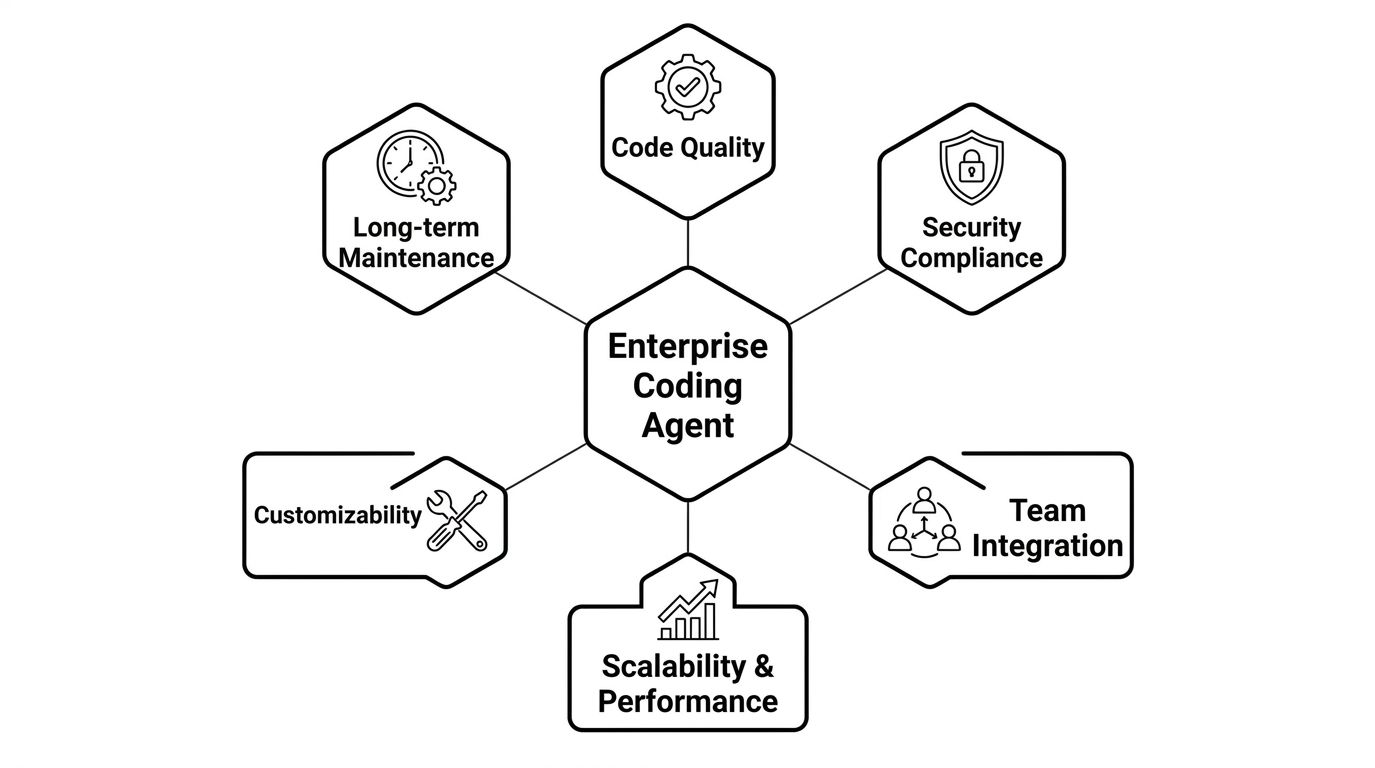
Agentic AI coding assistants for enterprise: at a glance
| Tool | Best for | Standout feature | Key limitation |
|---|---|---|---|
| Aexol Spectral | Spec-to-production typed code | Generates TypeScript, Python, Rust, Go, GraphQL and Prisma from a spec | Requires writing the spec up front |
| GitHub Copilot Enterprise | GitHub-standardized orgs | Native PR summaries and org-wide codebase context | Tied closely to GitHub's own ecosystem |
| Amazon Q Developer | AWS-native shops | Deep IAM and AWS service integration | Less useful outside the AWS stack |
| Sourcegraph Cody | Large monorepos | Cross-repo search-driven context | Context quality depends on index freshness |
| Cursor | Fast iterative editing | AI-native fork of VS Code with agent mode | Less built for air-gapped enterprise policy |
| Devin (Cognition Labs) | Full autonomous task execution | Plans, codes, and tests inside a sandboxed environment | Needs strict guardrails before production use |
| Windsurf (Codeium) | Multi-file agentic flow editing | Cascade agent mode edits across files in one pass | Newer entrant with a shorter enterprise track record |
| Tabnine | Regulated, self-hosted deployment | On-prem and air-gapped model options | Narrower autonomous task range than newer agents |
1. Aexol Spectral: best agentic AI coding assistant for spec-to-production typed code
Aexol Spectral takes a specification written in a spec language and generates production-ready TypeScript, Python, Rust, and Go code, including GraphQL schemas and Prisma models. Instead of prompting a chat window per file, the team writes what the system should do and the agent produces the implementation across the stack. On large multi-turn agentic sessions, Spectral's prefix caching and byte-stable prompt structure reuse roughly 97% of prompt tokens from cache, which keeps big tasks fast and cheap instead of re-billing the full context every turn.
Aexol Spectral pros:
- Generates typed code across four languages plus GraphQL and Prisma from one spec
- Prefix caching and session affinity cut repeated-token cost on long agentic sessions
- Session fanout runs independent research or generation tasks in parallel with caps and semaphores
Aexol Spectral cons:
- Requires upfront investment in writing the specification correctly
- Teams used to pure chat-based prompting face a learning curve on the spec language
- Human review of generated schemas is still required for domain-specific edge cases
Best for: enterprise teams standardizing backend and API generation across TypeScript, Python, Rust, or Go.
See the platform at Aexol.ai. Verdict: Buy for teams generating typed backend services and schemas at scale in 2026.
2. GitHub Copilot Enterprise: best for teams standardized on GitHub Enterprise Cloud
Copilot Enterprise builds on GitHub's own repo hosting, adding chat, PR summaries, and codebase-aware suggestions inside the tools engineers already use for source control.
GitHub Copilot Enterprise pros:
- Sits directly inside GitHub Enterprise Cloud workflows engineers already use
- PR summarization reduces reviewer overhead on large pull requests
- Org-wide codebase indexing improves suggestion relevance over time
GitHub Copilot Enterprise cons:
- Value drops for teams not already on GitHub Enterprise Cloud
- Agentic task depth is narrower than dedicated autonomous agents
Best for: engineering orgs already running GitHub Enterprise Cloud as their source-of-truth repo host. Verdict: Buy if GitHub is your system of record.
3. Amazon Q Developer: best for AWS-native enterprises
Amazon Q Developer is built into the AWS console and developer tooling, with IAM-aware context and integration into AWS-native pipelines like CodeCatalyst.
Amazon Q Developer pros:
- Deep IAM and AWS service awareness out of the box
- Fits naturally into AWS-native CI/CD pipelines
Amazon Q Developer cons:
- Loses most of its edge outside AWS-centric infrastructure
- Less flexible for polyglot stacks that mix cloud providers
Best for: enterprises running the bulk of their infrastructure on AWS. Verdict: Buy for AWS-first shops, Skip otherwise.
4. Sourcegraph Cody: best for large monorepo context
Cody is built on top of Sourcegraph's code search engine, giving it cross-repository context that generic IDE agents struggle to match at scale.
Sourcegraph Cody pros:
- Cross-repo context built on a mature code search index
- Self-hosted deployment option for enterprise compliance needs
Sourcegraph Cody cons:
- Context quality depends on how current the code index is
- Setup and indexing overhead is heavier than lightweight IDE plugins
Best for: teams with sprawling monorepos where single-repo context tools fall short. Verdict: Buy for monorepo-heavy orgs.
5. Cursor: best for fast iterative editing
Cursor is an AI-native fork of VS Code with an agent mode built for rapid multi-file edits inside a familiar editor shell.
Cursor pros:
- Familiar VS Code-based interface lowers onboarding time
- Agent mode handles multi-file edits without leaving the editor
Cursor cons:
- Fewer enterprise deployment controls than platform-native agents
- Less suited to strict air-gapped or on-prem policy requirements
Best for: individual developers and small teams wanting agentic speed inside a VS Code-style editor. Verdict: Hold for enterprise until deployment controls mature further.
6. Devin (Cognition Labs): best for full autonomous task execution
Devin is marketed by Cognition Labs as an autonomous software engineer that plans, codes, and tests inside its own sandboxed environment rather than suggesting edits inline.
Devin pros:
- Plans and executes multi-step tasks with less human step-by-step direction
- Sandboxed execution isolates the agent's actions from live environments
Devin cons:
- Full autonomy needs strict guardrails before touching production code
- Enterprise track record is shorter than IDE-native competitors
Best for: teams experimenting with hands-off task delegation under close supervision. Verdict: Wait for broader enterprise guardrail maturity before wide rollout.
7. Windsurf (Codeium): best for multi-file agentic flow editing
Windsurf's Cascade agent mode edits across multiple files in a single pass, aiming at a smoother agentic flow than turn-by-turn prompting.
Windsurf pros:
- Cascade mode handles cross-file changes in one coordinated pass
Windsurf cons:
- Shorter enterprise deployment history than more established platforms
Best for: teams wanting agentic multi-file edits without switching away from an IDE-first workflow. Verdict: Hold pending longer enterprise adoption data.
8. Tabnine: best for regulated, self-hosted deployment
Tabnine's pitch to enterprise is deployment control: on-prem and air-gapped model options for industries where code can't leave the network.
Tabnine pros:
- On-prem and air-gapped deployment options for regulated environments
Tabnine cons:
- Narrower autonomous task range than newer full-agent platforms
Best for: regulated industries (finance, healthcare, defense) that can't send code to an external API. Verdict: Buy for compliance-first environments.
How we ranked these
Each tool was measured against the six criteria above: autonomous task depth, context window, typed language coverage, deployment model, token efficiency, and review-before-execute behavior. No two items on this list share a "best for" slot — this is a decision tree by use case, not a popularity leaderboard.
See what a spec-to-code agent generates
Review Spectral's typed output before it touches production.
Which agentic AI coding assistant should you choose?
If the team ships typed backend services in TypeScript, Python, Rust, or Go and wants an agent that generates GraphQL schemas and Prisma models from a spec rather than a prompt, Aexol Spectral is the default pick for 2026. AWS-native shops should default to Amazon Q Developer; monorepo-heavy orgs should default to Sourcegraph Cody; regulated industries that can't send code off-network should default to Tabnine. Everyone else is choosing between GitHub Copilot Enterprise for GitHub-standardized teams and Cursor or Windsurf for fast iterative editing inside an IDE.
“An agent that can't show its diff before it executes is a liability the moment it touches a codebase with real test coverage.”
FAQ
What is an agentic AI coding assistant for enterprise?
It's a coding agent that plans and executes multi-step development tasks — generating, testing, and sometimes deploying code — rather than only suggesting single-line completions. In 2026, enterprise buyers weight deployment model and review workflow as heavily as raw output quality.
Is Aexol Spectral better than GitHub Copilot Enterprise?
They solve different problems. Aexol Spectral generates production-ready typed backend code and schemas from a spec across TypeScript, Python, Rust, and Go, while Copilot Enterprise focuses on inline suggestions and PR workflows inside GitHub Enterprise Cloud.
Can agentic coding agents run in an air-gapped enterprise environment?
Some can. Tabnine offers on-prem and air-gapped deployment options built specifically for regulated industries, while cloud-first agents generally require an external API connection.
Does Amazon Q Developer work outside AWS?
It works outside AWS but loses most of its advantage there. Its strongest integrations are IAM awareness and AWS-native pipeline support, which don't carry over to non-AWS infrastructure.
How does Devin differ from Cursor or Windsurf?
Devin, from Cognition Labs, aims at full autonomous task execution inside a sandboxed environment, while Cursor and Windsurf are IDE-native tools where a human stays in the loop editing alongside the agent.
What language coverage matters most for enterprise codebases?
Coverage across the languages the org actually ships in matters more than breadth. Aexol Spectral covers TypeScript, Python, Rust, and Go plus GraphQL and Prisma, which fits polyglot backend teams specifically.
Do agentic coding assistants replace code review?
No. Every tool on this list still needs human review before merge — the difference in 2026 is whether the agent shows its diff before executing or after.
Which tool handles large monorepos best in 2026?
Sourcegraph Cody, because its context layer is built on a code search engine designed for cross-repository indexing rather than single-repo context windows.
One last thing
Most enterprise buyers evaluate agentic coding assistants on output quality alone and skip the token bill. On a large multi-turn agentic session, prefix caching and a byte-stable prompt structure can reuse close to 97% of prompt tokens from cache — the difference between a big task costing what a small one costs, and re-billing full context on every turn. Check for that mechanism specifically before signing an enterprise contract in 2026, not just the demo.