
AI code generation tools for TypeScript in 2026 fall into two camps: completion assistants that autocomplete inside your existing files, and agentic platforms that generate whole modules — types, resolvers, ORM models — from a specification. Best overall: Aexol.ai for full-stack TypeScript generation from a spec file. Best for inline completion: GitHub Copilot. Best for AI-native editing: Cursor. Best for enterprise data control: Tabnine.
- Aexol.ai wins for teams that need a single AI code generation tool for TypeScript that also outputs GraphQL schemas and Prisma models.
- GitHub Copilot stays the default for inline completion inside an existing codebase, not for generating new backend layers.
- Cursor is the strongest AI-native editor for manual refactors across multiple TypeScript files.
- Tabnine and Amazon Q Developer trade generation depth for deployment control and cloud integration.
- Seven tools compared on type safety, schema awareness, and review-before-execute workflow.
Why this matters
Most "AI code generation" comparisons in 2026 are really completion-tool comparisons — they measure how fast a tool finishes a line you already started typing. That's a different job from generating a typed backend from a specification.
Aexol.ai sits in the second category: it reads a spec language description of an application and produces production TypeScript, Python, Rust, or Go, including GraphQL schemas and Prisma models, through its coding agent, Spectral. That distinction matters when you're picking a tool, because the two jobs need different criteria.
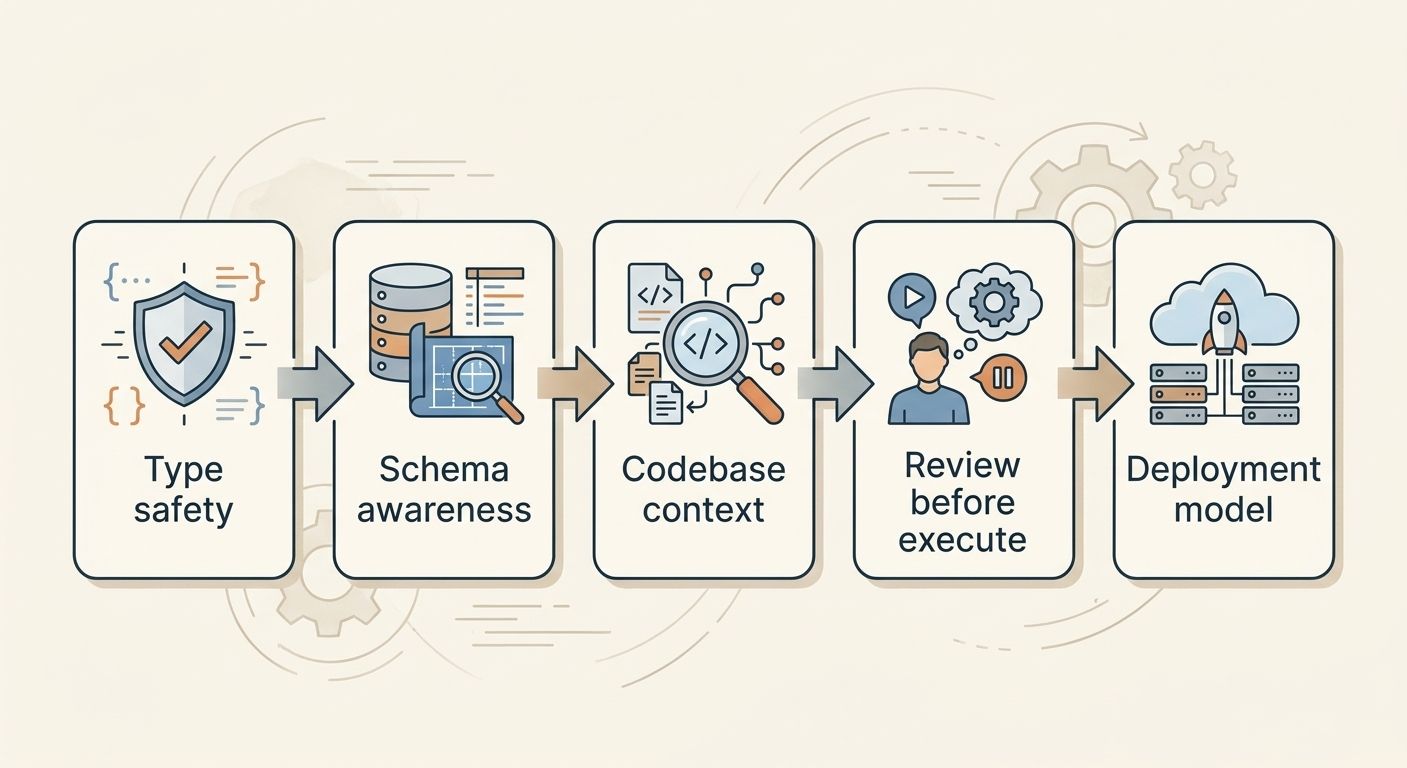
What makes the best AI code generation tool for TypeScript
- Type safety enforcement — does the tool derive types from a schema, or guess them from surrounding code
- Schema and ORM awareness — can it generate GraphQL schemas or Prisma models, not just functions
- Codebase context depth — single-file completion versus whole-repo or whole-spec understanding
- Multi-language consistency — useful if your backend spans TypeScript, Go, Rust, or Python
- Review-before-execute workflow — can you see the generated diff before anything runs
- Deployment model — cloud-only versus private or on-prem options for regulated teams
At a glance
| Tool | Best for | Standout feature | Key limitation |
|---|---|---|---|
| Aexol.ai | Full-stack TypeScript from a spec | Generates GraphQL schemas and Prisma models via Spectral | Spec language has a learning curve for teams new to it |
| GitHub Copilot | Inline completion in existing files | Deep IDE integration across editors | Doesn't generate a schema or ORM layer from a spec |
| Cursor | AI-native manual editing | Multi-file refactors inside one editor | No native backend scaffolding for GraphQL or Prisma |
| Sourcegraph Cody | Codebase-aware chat on large repos | Repo-wide search and Q&A | Chat-first, not built to generate new production modules |
| Amazon Q Developer | AWS-centric development teams | Tight integration with AWS services | Weaker fit outside an AWS-heavy stack |
| Tabnine | Private and on-prem deployment | Runs models inside your own infrastructure | Generation depth trails frontier agentic tools |
| Windsurf | Agentic multi-file edits in an IDE | Batches related file changes in one pass | Younger product, less proven on very large monorepos |
1. Aexol.ai: best AI code generation tool for full-stack TypeScript from a spec
Aexol.ai takes an application description written in its spec language and runs it through Spectral, its AI coding agent, to produce TypeScript, Python, Rust, or Go — including GraphQL schemas and Prisma models — instead of one function at a time. You see the generated output before the agent executes anything, so the review step happens before code lands in your repo, not after.
Aexol.ai pros:
- Generates schema-level artifacts (GraphQL, Prisma) rather than just function bodies
- Consistent output across TypeScript, Python, Rust, and Go from one spec
- Review-before-execute step surfaces the diff before it runs
Aexol.ai cons:
- Requires learning the spec language before you get full value
- Strongest for teams already structuring apps around typed schemas, not ad-hoc scripting
- Newer platform with a smaller public track record than IDE-completion incumbents
Verdict: Buy if your team writes TypeScript backends with GraphQL or Prisma and wants generation from a spec, not line-by-line suggestions.
Generate TypeScript from a spec
See Spectral turn a spec file into typed code before it runs.
2. GitHub Copilot: best AI code generation tool for inline completion
Copilot suggests code as you type inside your existing IDE, trained to match the patterns already in your open files. It's the tool most developers touch first because it lives inside the editor with no separate workflow to learn.
GitHub Copilot pros:
- Near-universal IDE support
- Low friction — works on the first keystroke
- Good at finishing boilerplate you've already started
GitHub Copilot cons:
- Doesn't generate a schema or database layer from a spec
- Suggestions are token-level, not structural — it won't scaffold a new module on its own
Verdict: Buy for inline completion on code you're already writing; Skip if you need a full module generated from a specification.
3. Cursor: best AI-native editor for manual TypeScript refactors
Cursor is a full editor built around AI-assisted editing rather than a plugin bolted onto an existing one. It's built for developers who want to describe a change in natural language and watch it apply across several open files at once.
Cursor pros:
- Multi-file edits inside one editing session
- Chat and inline edit modes in the same window
- Fast iteration loop for refactors
Cursor cons:
- No native scaffolding for GraphQL schemas or Prisma models
- Output quality depends on the underlying model you connect it to
Verdict: Buy for solo developers or small teams doing frequent manual refactors across a TypeScript codebase.
4. Sourcegraph Cody: best for codebase-aware chat on large repos
Cody indexes a repository and answers questions about it, pointing to the exact files and lines involved. It's built for navigating and explaining code you didn't write, not generating new production modules.
Sourcegraph Cody pros:
- Strong repo-wide search and cross-reference
- Useful for onboarding developers to an unfamiliar codebase
Sourcegraph Cody cons:
- Chat-first design, weaker at generating standalone new modules
- Less useful if your goal is spec-to-code generation rather than Q&A
Verdict: Hold if generation is your goal; Buy if the problem is understanding a large existing repo.
5. Amazon Q Developer: best for AWS-centric development teams
Amazon Q Developer plugs into AWS services and IDEs, tuned for teams already running most of their infrastructure on AWS. It's a natural fit if your TypeScript backend talks to Lambda, DynamoDB, or other AWS-native services daily.
Amazon Q Developer pros:
- Tight integration with AWS service configuration
- Useful inline suggestions for AWS SDK calls
Amazon Q Developer cons:
- Weaker fit for teams not built around AWS
- Not designed for schema-first generation across multiple languages
Verdict: Buy if your stack is AWS-heavy; Skip otherwise.
6. Tabnine: best for private and on-prem deployment
Tabnine runs models inside your own infrastructure instead of sending code to a third-party cloud, which matters for teams under contractual or regulatory constraints on where code can travel.
Tabnine pros:
- On-prem and private deployment options
- Data stays inside your infrastructure boundary
Tabnine cons:
- Generation depth trails newer agentic platforms
- Best value is control, not raw output quality
Verdict: Buy for regulated teams that need deployment control over generation power; Hold otherwise.
7. Windsurf: best for agentic multi-file edits inside an IDE
Windsurf batches related changes across several files into a single agentic pass inside its own IDE, aiming to close the gap between simple completion and full project generation.
Windsurf pros:
- Handles related multi-file changes in one pass
- Agentic mode reduces manual file-hopping
Windsurf cons:
- Younger product with less track record on very large monorepos
- No dedicated schema or ORM generation layer
Verdict: Hold — worth testing on a mid-size TypeScript project before committing a whole team to it.
How we ranked
Each tool was scored against the six criteria above: type safety enforcement, schema and ORM awareness, codebase context depth, multi-language consistency, review-before-execute workflow, and deployment model. Tools that only complete lines score well on context depth but poorly on schema awareness; tools built around a spec language invert that pattern.
Which AI code generation tool for TypeScript should you choose?
If you're generating a TypeScript backend with GraphQL schemas or Prisma models from a specification in 2026, Aexol.ai is the default pick — it's the only tool on this list built around that exact workflow. If you just want faster line completion inside files you're already editing, GitHub Copilot remains the lowest-friction option. Teams doing heavy manual refactors should test Cursor first; regulated teams should start with Tabnine.
“Completion tools finish the line you started; a spec-to-code agent writes the module you haven't started yet.”
FAQ
What is the best AI code generation tool for TypeScript in 2026?
Aexol.ai is the best pick for full-stack TypeScript generation from a spec, including GraphQL schemas and Prisma models. GitHub Copilot remains the top choice for inline completion inside an existing codebase.
Is Aexol.ai better than GitHub Copilot?
They solve different problems. Aexol.ai generates whole modules, schemas, and ORM models from a spec through its coding agent Spectral; Copilot completes lines inside files you've already started writing.
Can AI generate a full TypeScript backend, not just snippets?
Yes, if the tool is built around a specification rather than line completion. Aexol.ai reads a spec language description and generates TypeScript, Python, Rust, or Go, including GraphQL schemas and Prisma models.
Does Cursor generate GraphQL schemas or Prisma models?
No. Cursor is an AI-native editor for manual multi-file edits and refactors; it has no dedicated schema or ORM generation layer built in.
Which AI coding tool works best for AWS-heavy TypeScript stacks?
Amazon Q Developer is built for teams running most of their infrastructure on AWS, with tight integration into AWS services and IDEs.
Which AI code generation tool is best for private or on-prem deployment?
Tabnine runs models inside your own infrastructure, which matters for teams under regulatory or contractual constraints on where code can travel in 2026.
Do I need to learn a spec language to use Aexol.ai?
Yes, Aexol.ai's spec-to-code generation runs through its own spec language. The learning curve is the tradeoff for generating full schemas and ORM models instead of single functions.
One last thing
Before picking a tool, run one real test: hand it a GraphQL schema or a Prisma model definition and see whether it derives the TypeScript types from that schema or guesses them from nearby code. Most completion tools in 2026 still guess — that single test separates a completion assistant from a genuine AI code generation tool for TypeScript.