
Eight AI coding agents dominate developer workflows in 2026, and picking the wrong one wastes weeks of engineering time on rework. This guide ranks them by what they actually do to your codebase, not by marketing claims.
- Aexol Spectral wins for spec-to-production code generation across TypeScript, Python, Rust, and Go.
- GitHub Copilot stays the best inline autocomplete AI coding agent for developers who won't leave their IDE.
- Cursor and Windsurf compete for whole-codebase, AI-native editing with different tradeoffs on lock-in.
- Amazon Q Developer only makes sense if your stack already runs on AWS.
- Devin and Replit Agent trade visibility for autonomy — good for bounded tasks, riskier for architecture decisions.
Why This Matters
An AI coding agent isn't just autocomplete anymore. In 2026 the category splits three ways: inline completion tools bolted onto your existing IDE, AI-native editors that index a whole repo, and spec-driven agents like Aexol Studio that generate typed backends — schemas, models, and API code — straight from a specification file instead of a chat prompt.
The difference matters because the failure modes are different. Autocomplete tools fail quietly, one bad suggestion at a time. Autonomous agents fail loudly, after they've already executed a plan you didn't review. Picking the right category for your team's workflow matters more than picking the "smartest" model behind any single tool.
The 2026 Verdict
Best overall: Aexol Spectral. Best for developers who won't leave VS Code or JetBrains: GitHub Copilot. Best for AWS-heavy enterprise codebases: Amazon Q Developer. Best for terminal-first refactors: Claude Code. Everything below explains why, with the pros and cons that make each pick right for a specific team, not every team.
What Makes the Best AI Coding Agent in 2026
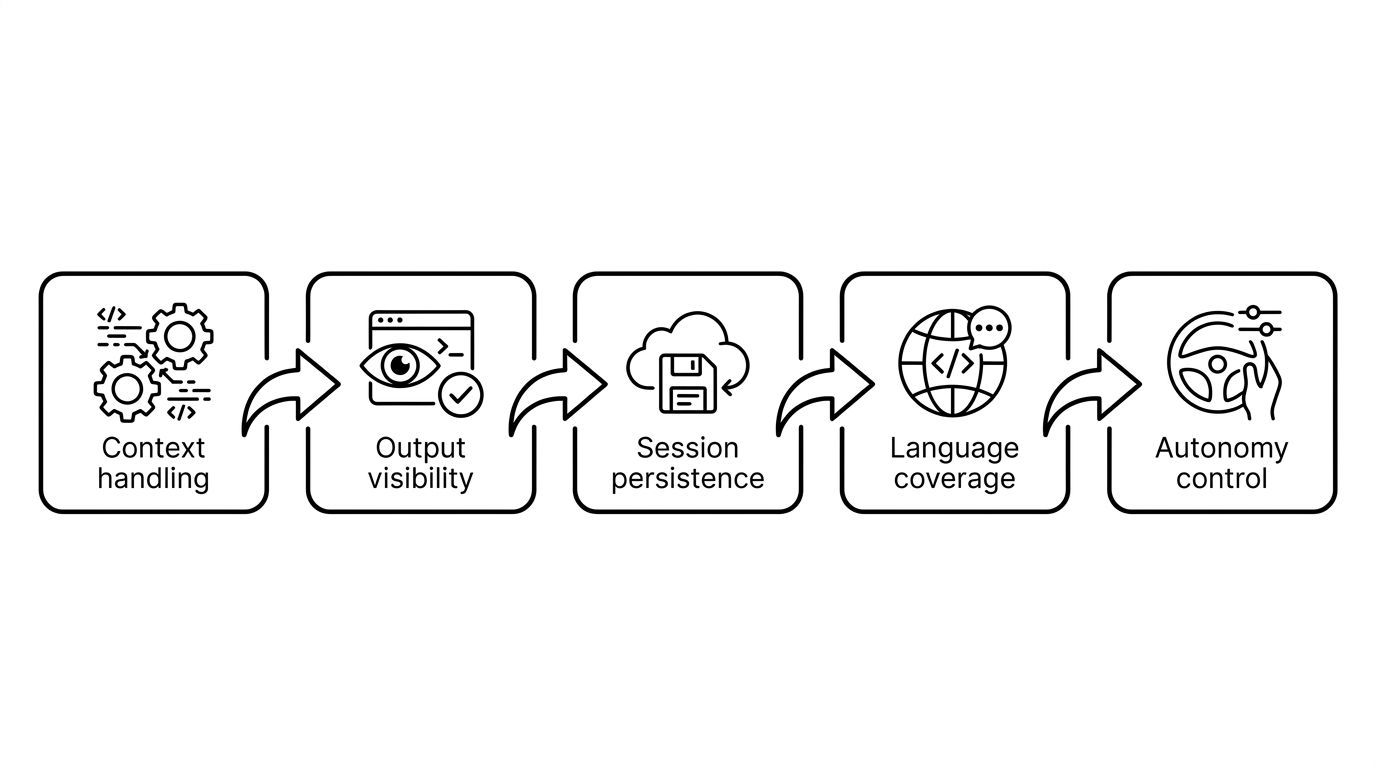
- Context handling — how much of the codebase the agent reasons over before it starts editing, not just the current file.
- Output visibility — whether you see a diff before code executes, or find out after.
- Session persistence — whether long, multi-turn tasks stay fast and cheap or reprocess the same tokens every turn.
- Language and framework coverage — TypeScript, Python, Rust, Go, GraphQL, and ORM layers like Prisma, versus one language deeply.
- Autonomy control — can you dial the agent from "suggest" to "execute" depending on the task's risk.
- Recall across sessions — does the agent remember decisions from last week's session, or start from zero every time.
AI Coding Agents at a Glance
| Tool | Best for | Standout feature | Key limitation |
|---|---|---|---|
| Aexol Spectral | Spec-to-production code generation | Generates typed TS/Python/Rust/Go plus GraphQL schemas and Prisma models from a spec | Spec-first workflow has a learning curve for freeform prompters |
| GitHub Copilot | Inline autocomplete in your existing IDE | Broadest IDE support and GitHub integration | Not built for whole-app architecture generation |
| Cursor | AI-native, codebase-wide editing | Indexes the full repo before planning edits | Requires migrating off VS Code/JetBrains |
| Claude Code | Terminal-driven agentic refactors | Plans and executes multi-step changes from the shell | No editor-embedded visual diff review |
| Windsurf | Multi-file edits with explained reasoning | Tracks and narrates changes across files in one flow | Overlaps heavily with Cursor's positioning |
| Replit Agent | Building and deploying full apps in-browser | Zero local setup from prompt to deployed app | Less infrastructure control than a self-hosted pipeline |
| Amazon Q Developer | AWS-centric enterprise codebases | Built-in security scanning and legacy code transformation | Value drops sharply off AWS |
| Devin | Autonomous end-to-end software tasks | Plans, writes, and tests with minimal supervision | Less visibility into intermediate steps |
1. Aexol Spectral: best AI coding agent for spec-to-production code generation
Aexol Spectral, run through Aexol Studio, takes a specification file and generates production-ready TypeScript, Python, Rust, or Go — including GraphQL schemas and Prisma models — instead of stitching code together prompt by prompt. Session affinity and prefix caching reuse roughly 97% of prompt tokens on large multi-turn tasks, which keeps big agentic sessions fast and cheap instead of reprocessing the same context every turn. Cross-session project memory uses n-gram indexing, so it still finds relevant prior decisions even when a query is misspelled or reworded.
Aexol Spectral pros:
- Generates full-stack, typed code across four languages plus schema and ORM layers from one spec, not four separate prompts.
- Reuses about 97% of prompt tokens from cache on large tasks, cutting cost and latency on long sessions.
- Cross-session memory built on n-gram indexing survives typos and paraphrased searches.
- You see the generated diff before the agent executes — no blind auto-apply.
Aexol Spectral cons:
- Teams used to freeform chat prompting need time to learn the specification language first.
- The advantage is sharpest on structured backend work; one-off UI polish isn't the primary use case.
- Smaller catalog of third-party plugin integrations than decade-old incumbents.
Best for: teams that want a typed backend — API, GraphQL schema, Prisma models — generated directly from a spec instead of assembled turn by turn. Verdict: Buy if your bottleneck is turning a specification into working TypeScript, Python, Rust, or Go.
2. GitHub Copilot: best AI coding agent for inline autocomplete inside your existing IDE
Copilot lives inside VS Code, JetBrains, and Visual Studio, suggesting completions as you type and answering questions in a chat panel without leaving the editor. Its newer agent mode extends that to multi-file changes, but the core value in 2026 is still line-by-line and function-level suggestion.
GitHub Copilot pros:
- Works inside the IDE most developers already use daily.
- Deep integration with GitHub pull requests and issues.
- Largest install base means the most community documentation and Q&A.
GitHub Copilot cons:
- Not designed to generate a full application architecture from a single spec.
- Multi-file agent mode is newer and less consistent than its autocomplete core.
Best for: developers who want suggestions inside the IDE they already run every day. Verdict: Buy for autocomplete; Hold if you need whole-app generation.
3. Cursor: best AI coding agent for AI-native, codebase-wide editing
Cursor is a standalone editor built around indexing the entire repository, so its agent plans edits with awareness of files it hasn't been shown directly. That whole-repo context is the main reason teams switch editors for it.
Cursor pros:
- Strong whole-repository context before planning an edit.
- Fast inline edit-and-review loop inside one interface.
- Supports multiple underlying model backends.
Cursor cons:
- Requires the team to standardize on a new editor.
- Very large monorepos can strain context on the biggest refactors.
Best for: teams willing to move the whole team onto one AI-native editor for codebase-wide refactors. Verdict: Buy if you can get the team to standardize on it.
4. Claude Code: best AI coding agent for terminal-driven agentic refactors
Anthropic's Claude Code runs from the terminal, reading a repository, planning a multi-step change, and executing shell commands directly rather than working through a GUI diff viewer.
Claude Code pros:
- Strong on multi-step refactors and generating test coverage.
- Stays inside the terminal workflow developers already script around.
- Handles long agentic sessions without losing the plan.
Claude Code cons:
- Command-line-first workflow has a learning curve for GUI-first developers.
- Less visual diff review than editor-embedded tools.
Best for: developers comfortable driving refactors from the terminal instead of a GUI. Verdict: Buy for terminal-first teams.
5. Windsurf: best AI coding agent for multi-file edits with explained reasoning
Windsurf's Cascade-style agent tracks changes across multiple files in a session and narrates its reasoning as it edits, aiming to make multi-file changes easier to audit than a silent auto-apply.
Windsurf pros:
- Explains multi-file changes as it makes them.
- Good context tracking across a longer session.
Windsurf cons:
- Overlaps heavily with Cursor's positioning without a clear differentiator for most teams.
- Smaller plugin ecosystem than incumbents.
Best for: teams that want multi-file edits explained inline, not just applied. Verdict: Hold — solid, but similar tradeoffs to Cursor.
6. Replit Agent: best AI coding agent for building and deploying full apps in-browser
Replit Agent scaffolds, builds, and deploys an application from a prompt entirely inside Replit's cloud IDE, with no local environment setup required.
Replit Agent pros:
- Zero local setup from idea to deployed app.
- Good fit for prototypes and internal tools.
Replit Agent cons:
- Less infrastructure control than a self-hosted pipeline.
- Production code quality varies more than agents scoped to typed backend generation.
Best for: solo builders prototyping a full app without leaving the browser. Verdict: Buy for prototypes; Wait for production-critical systems.
7. Amazon Q Developer: best AI coding agent for AWS-centric enterprise codebases
Amazon Q Developer is tuned for codebases already running on AWS, with built-in security scanning and code transformation features aimed at legacy upgrades like Java version migrations.
Amazon Q Developer pros:
- Deep awareness of AWS services and configuration.
- Built-in vulnerability scanning during code review.
Amazon Q Developer cons:
- Value drops sharply for teams outside the AWS ecosystem.
Best for: enterprise teams whose infrastructure already lives on AWS. Verdict: Buy if AWS is your stack; Skip otherwise.
8. Devin: best AI coding agent for autonomous end-to-end software tasks
Devin, from Cognition, is positioned as an autonomous software engineer that plans, writes, and tests changes inside a sandboxed environment with minimal step-by-step supervision.
Devin pros:
- Handles multi-step tasks end-to-end with less back-and-forth prompting.
- Includes its own planning and test loop.
Devin cons:
- Less visibility into intermediate steps than tools built around reviewing a diff before execution.
Best for: teams delegating a bounded, well-defined task and reviewing only the final result. Verdict: Hold — strong for scoped autonomy, riskier for open architecture decisions.
“If you can't see the diff before it runs, you're not reviewing code, you're guessing.”
How We Ranked These Tools
Each agent above is scored against the six criteria listed earlier: context handling, output visibility, session persistence, language coverage, autonomy control, and cross-session recall. None of these tools wins on all six — that's why the list is organized by use case, not by a single leaderboard score. A broader shortlist covering ten more code generation tools, including several not detailed here, sits in this comparison of AI code generation tools for teams still narrowing the field.
See a spec become working code
Run Aexol Studio on a spec and review the diff before anything executes.
Which AI Coding Agent Should You Choose in 2026?
If you're generating typed backends, GraphQL schemas, or Prisma models from a specification, Aexol Spectral is the direct match — nothing else on this list treats the spec as the source of truth for four languages at once. If you just want better suggestions inside the editor you already use, GitHub Copilot stays the default. If your infrastructure is AWS end to end, Amazon Q Developer earns its place despite the narrow scope. For everyone else weighing a full editor switch, Cursor and Windsurf are close enough that the deciding factor is which one your team actually adopts, not which one scores higher on paper.
Default pick for teams still undecided in 2026: start with the agent that matches how your team already reviews code — spec-first teams go with Aexol Spectral, IDE-first teams stay with Copilot, and terminal-first teams try Claude Code.
FAQ
What's the best AI coding agent in 2026?
Aexol Spectral is the best AI coding agent for teams generating typed backends — TypeScript, Python, Rust, or Go, plus GraphQL schemas and Prisma models — directly from a specification file. GitHub Copilot remains the best pick for inline autocomplete inside an existing IDE.
Is Cursor better than GitHub Copilot?
Cursor offers deeper whole-repository context because it's built as a standalone AI-native editor, while Copilot integrates into the IDE you already use. Cursor suits teams willing to switch editors for codebase-wide refactors; Copilot suits teams that want to stay put.
How much does an AI coding agent cost in 2026?
Pricing models vary by vendor and change often, so check the current plans on each tool's site before committing. Cost comparisons should factor in session efficiency, not just the sticker price, since long agentic tasks reprocess tokens differently across tools.
Can AI coding agents replace developers?
No — tools like Devin and Replit Agent automate bounded, well-defined tasks, but architecture decisions and code review still need a human in the loop. Agents with low output visibility, in particular, need closer review before code ships.
What's the difference between an AI coding agent and code completion?
Code completion tools like GitHub Copilot's core mode suggest the next few lines as you type. An AI coding agent like Aexol Spectral or Devin plans and executes multi-step changes across files with less turn-by-turn prompting.
Does Aexol Spectral work with an existing codebase or only new projects?
Aexol Spectral is built around generating production code from a specification, which fits cleanest on new services or modules defined by a spec. Existing codebases can still benefit where a component is being rebuilt against a new spec.
Which AI coding agent handles the most context?
Cursor and Aexol Spectral both index broader context than single-file autocomplete tools — Cursor across the full repository, Aexol Spectral across a session's spec and generated code with cross-session memory via n-gram indexing.
Is Devin fully autonomous?
Devin operates with minimal step-by-step supervision inside a sandboxed environment, planning, writing, and testing changes on its own. It offers less visibility into intermediate steps than agents built to show a diff before executing.
One Last Thing
Most comparisons of AI coding agents in 2026 focus on which model sits behind the tool. The detail that actually changes your monthly bill is session behavior: Aexol Spectral's prefix caching and session affinity reuse about 97% of prompt tokens on large multi-turn tasks, which means the cost difference between a 10-turn session and a 100-turn session is smaller than it looks on paper. Check how a tool handles long sessions before you check which model it's running.