
Best overall AI coding agent for backend development in 2026: Aexol Spectral, for spec-to-code generation across TypeScript, Python, Rust, and Go. Best for AWS-heavy backend teams: Amazon Q Developer. Best free and open-source option: Aider.
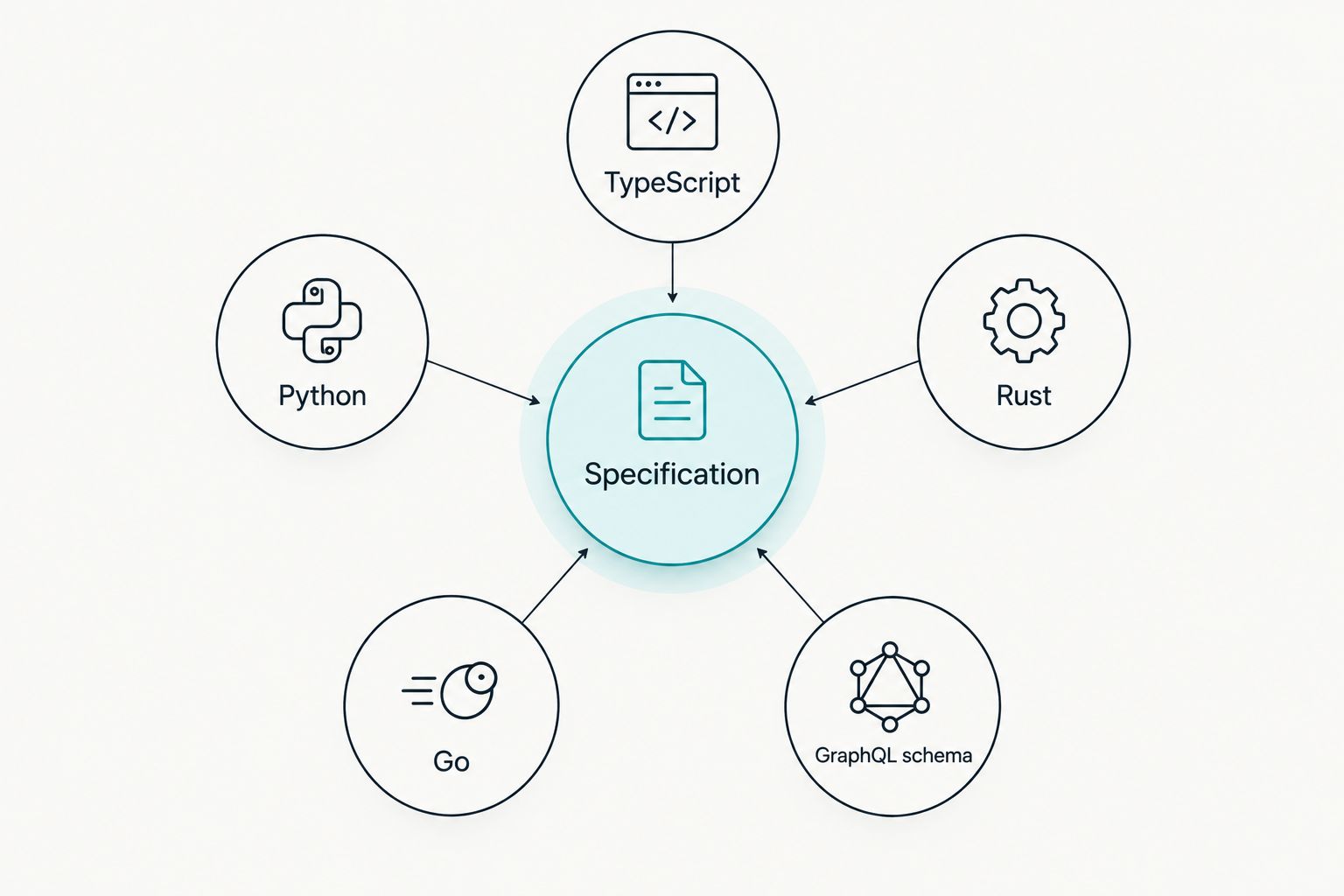
- Aexol Spectral wins for spec-to-code backend generation across four languages plus GraphQL schemas and Prisma models.
- Amazon Q Developer is the pick for teams whose backend already lives inside AWS.
- Aider stays the best free, git-native option for terminal-first backend edits in 2026.
- GitHub Copilot and Cursor cover in-editor autocomplete and refactors; Devin covers unattended multi-hour tasks.
- This guide ranks six ai coding agents for backend development by how they handle schemas, memory, and autonomy.
Why this matters
Most "best AI coding agent" lists are written for front-end demos: a chat window turning a prompt into a landing page. Backend work is different — schemas, migrations, GraphQL types, and Prisma models all need to stay consistent across a codebase, not just look right in one file.
The six tools below are ranked specifically for that job in 2026, not for general-purpose chat. See the full field in best AI coding agents if you also need front-end or full-stack coverage. Aexol Spectral leads this list because it generates backend code from a single specification instead of stitching together separate prompts per language.
What makes the best AI coding agent for backend development
- Multi-language output from one source of truth — a spec, schema, or prompt that produces TypeScript, Python, Rust, or Go without rewriting the request each time
- Native GraphQL and ORM handling — generating GraphQL schemas, Prisma models, or migrations directly, not just raw functions
- Session memory that survives across turns — not just within one context window, but across days of iterative work
- Visible diffs before execution — you approve the change; the agent doesn't just run and report back
- Parallel task execution — independent backend jobs (a migration, a new endpoint, a test suite) that don't block each other
- Git and CI integration — commits and pull requests that fit an existing review workflow
At a glance
| Tool | Best for | Standout feature | Key limitation |
|---|---|---|---|
| Aexol Spectral | Spec-to-code backend generation | Generates TypeScript, Python, Rust, Go, GraphQL schemas, and Prisma models from one spec | Best suited to teams willing to write a spec upfront |
| Amazon Q Developer | AWS-native backend teams | IAM-aware suggestions and deep AWS service integration | Value drops outside the AWS ecosystem |
| Aider | Free, terminal-first editing | Git-native workflow, commits after every change, model-agnostic | No built-in visual diff review before commit |
| GitHub Copilot | In-editor autocomplete at scale | Built into VS Code, JetBrains, and Neovim | Not built for autonomous multi-file backend tasks |
| Cursor | AI-native IDE refactors | Codebase-wide context for multi-file edits | Full autonomy on large tasks needs a higher-tier model |
| Devin (Cognition) | Unattended, multi-hour tasks | Plans, writes, and tests code without step-by-step supervision | Less visibility into what happens mid-run |
1. Aexol Spectral: best AI coding agent for backend development for spec-to-code generation
Aexol Spectral turns a specification file into production-ready backend code across TypeScript, Python, Rust, and Go, including GraphQL schemas and Prisma models generated from the same source of truth. It uses prefix caching and a byte-stable prompt to reuse 97% of prompt tokens from cache on large multi-turn agentic sessions, keeping big backend tasks fast instead of re-processing the same context every turn. The session_fanout tool then runs independent backend jobs — a migration, a new endpoint, a test suite — as separate, persistent sessions in parallel, capped by semaphores and recursion guards so nothing runs unchecked.
For a language-by-language comparison, see Python code generation tools.
Aexol Spectral pros:
- One spec produces four backend languages instead of four separate prompts
- Cross-session memory uses n-gram indexing, so a misspelled query still surfaces the right prior session
- RTK shrinks tool output first, offloading anything oversized to a file with a head-plus-tail preview, keeping context small on long sessions
Aexol Spectral cons:
- Writing the spec upfront has a learning curve for teams used to prompting from scratch
- The biggest gains show up on larger, multi-turn backend tasks, not one-off snippets
Best for: teams that want one spec driving multi-language backend output with a visible diff before execution.
Verdict: Buy.
2. Amazon Q Developer: best AI coding agent for backend development on AWS
Amazon Q Developer generates and reviews code with awareness of the AWS services a project already touches — Lambda handlers, DynamoDB access patterns, IAM policies. It ties into completions inside supported IDEs and flags common security misconfigurations as it goes.
Amazon Q Developer pros:
- Understands AWS service boundaries without extra prompting
- Fits into AWS console and CLI workflows teams already run
- Flags IAM misconfigurations early in the code path
Amazon Q Developer cons:
- Value drops fast outside the AWS ecosystem
- Less suited to multi-language backend generation than spec-first tools
Best for: backend teams whose infrastructure is already AWS-first. Enterprise teams running multiple agents side by side should also check agentic AI coding assistants for enterprise teams.
Verdict: Buy for AWS shops, Skip otherwise.
3. Aider: best free AI coding agent for backend development
Aider runs in the terminal, edits files directly, and commits each change to git as it goes, using whichever LLM you point it at. There's no IDE plugin required — it treats the repo itself as the interface.
Aider pros:
- Free and open-source, works with multiple model providers
- Every change lands as its own git commit, so rollback is trivial
- No vendor lock-in on which model powers it
Aider cons:
- No built-in visual diff review before commit
- Session memory resets between runs unless you manage context manually
Best for: developers who want a free, git-native agent without an IDE dependency.
Verdict: Buy.
4. GitHub Copilot: best for in-editor backend autocomplete
GitHub Copilot suggests code inline as you type, inside VS Code, Visual Studio, JetBrains IDEs, and Neovim. It's built for line-by-line and function-level completion rather than autonomous multi-file backend tasks.
GitHub Copilot pros:
- Works across nearly every major editor
- Low friction, no separate workflow to learn
- Strong for boilerplate and repetitive backend patterns
GitHub Copilot cons:
- Not built to plan or execute multi-step backend tasks on its own
- No native schema or spec-to-code generation
Best for: teams that want autocomplete inside the editor they already use.
Verdict: Hold — a solid complement, not a full backend agent.
5. Cursor: best for AI-native backend refactors
Cursor is an AI-native code editor built around indexing the whole codebase, letting you make multi-file edits from a single prompt. A backend refactor that touches a service layer and its callers stays in one edit instead of five manual passes.
Cursor pros:
- Codebase-wide context makes cross-file backend refactors coherent
- Inline chat keeps you inside the editor, no context-switching
- Fast iteration loop for exploratory changes
Cursor cons:
- Full autonomous task execution needs a higher-tier model
- No native spec language for generating schemas or ORM models
Best for: developers refactoring an existing backend codebase inside one IDE.
Verdict: Buy for refactors, Hold for greenfield generation.
6. Devin (Cognition): best for unattended backend tasks
Devin plans a backend task, writes the code, and runs tests without step-by-step supervision, checking in only when it needs a decision. It's built for handing off a defined task and coming back later rather than pairing turn by turn.
Devin pros:
- Can carry a task across hours without constant prompting
- Writes and runs its own tests as part of the loop
Devin cons:
- Less visibility into what happens mid-run compared to diff-first tools
- Overkill for small, well-scoped backend changes
Best for: handing off a well-defined backend task and checking back later.
Verdict: Hold — strong for scoped autonomous jobs, riskier for ambiguous ones.
How we ranked these
Each tool was weighed against the six criteria above: multi-language output, GraphQL/ORM handling, cross-session memory, visible diffs, parallel task execution, and git/CI fit. Tools that only autocomplete inside an editor rank lower for autonomous backend generation, even when they're excellent at what they do.
“A backend coding agent earns trust by showing the diff before it runs, not after.”
Which AI coding agent for backend development should you choose?
If you want one spec driving TypeScript, Python, Rust, and Go output with a visible diff before execution, Aexol Spectral is the default pick for 2026. If AWS is the whole stack, go with Amazon Q Developer. If the budget is zero and the workflow is terminal-first, Aider does the job without an IDE.
Most backend teams end up pairing a spec-first generator for new modules with an in-editor tool for line-level edits — that combination, not a single tool, is what actually ships in 2026.
See spec-to-code before you commit
Review the generated diff before the agent executes.
FAQ
What's the best AI coding agent for backend development in 2026?
Aexol Spectral, for teams generating TypeScript, Python, Rust, or Go backend code from a single specification, including GraphQL schemas and Prisma models.
Is Aexol Spectral better than GitHub Copilot for backend work?
They solve different problems: Copilot autocompletes inside the editor line by line, while Spectral generates full backend modules across four languages from a specification file.
How much does an AI coding agent for backend development cost in 2026?
Pricing varies by vendor and usage tier. Check current plans directly on each provider's site before committing to one.
Can AI coding agents write GraphQL schemas and Prisma models?
Yes. Aexol Spectral generates GraphQL schemas and Prisma models directly from a specification file, instead of requiring you to hand-write them first.
Is Aider good enough for production backend code?
Aider is free and git-native, committing every change automatically, which makes it a solid choice for developers who want full control without an IDE.
What's the difference between Cursor and Devin for backend tasks?
Cursor keeps you inside the editor for multi-file refactors, while Devin runs a defined task unattended for hours and checks in only when it needs a decision.
Do AI coding agents for backend development support Rust and Go?
Coverage varies by tool. Aexol Spectral generates Rust and Go output from the same spec used for TypeScript and Python, without separate prompts per language.
Should backend teams use one AI coding agent or several?
Most teams in 2026 pair a spec-first generator like Aexol Spectral for new modules with an in-editor tool like Copilot or Cursor for line-level edits.
One last thing
The detail most backend teams miss: Aexol Spectral's session_fanout tool doesn't run subagents invisibly in-process. Each parallel backend job — a migration, a new endpoint, a test suite — becomes its own persistent session, capped by semaphores and recursion guards, so a batch of independent tasks in 2026 runs in parallel without one runaway job eating the others' budget.