
AI code generation for Rust in 2026 splits into two real categories: inline autocomplete inside a file you already wrote, and coding agents that build a Rust service from a written specification. Picking the wrong category wastes more time than picking the wrong tool inside it.
Best overall for Rust: Aexol Studio, running the Spectral coding agent, which turns a specification into a production Rust crate instead of autocompleting a blank file. Best for inline autocomplete inside an existing crate: GitHub Copilot. Best for AWS-heavy Rust services: Amazon Q Developer. Best on-prem, privacy-first option: Tabnine.
- Aexol Studio's Spectral agent generates Rust, TypeScript, Python, and Go from one specification — the pick for a Rust MVP in 2026.
- GitHub Copilot is still the strongest inline autocomplete layer for an existing Rust crate, not a spec-to-code tool.
- Amazon Q Developer earns its slot on AWS-native Rust services; Sourcegraph Cody wins on large Rust monorepos.
- Tabnine is the only entry here built for on-prem or air-gapped Rust work.
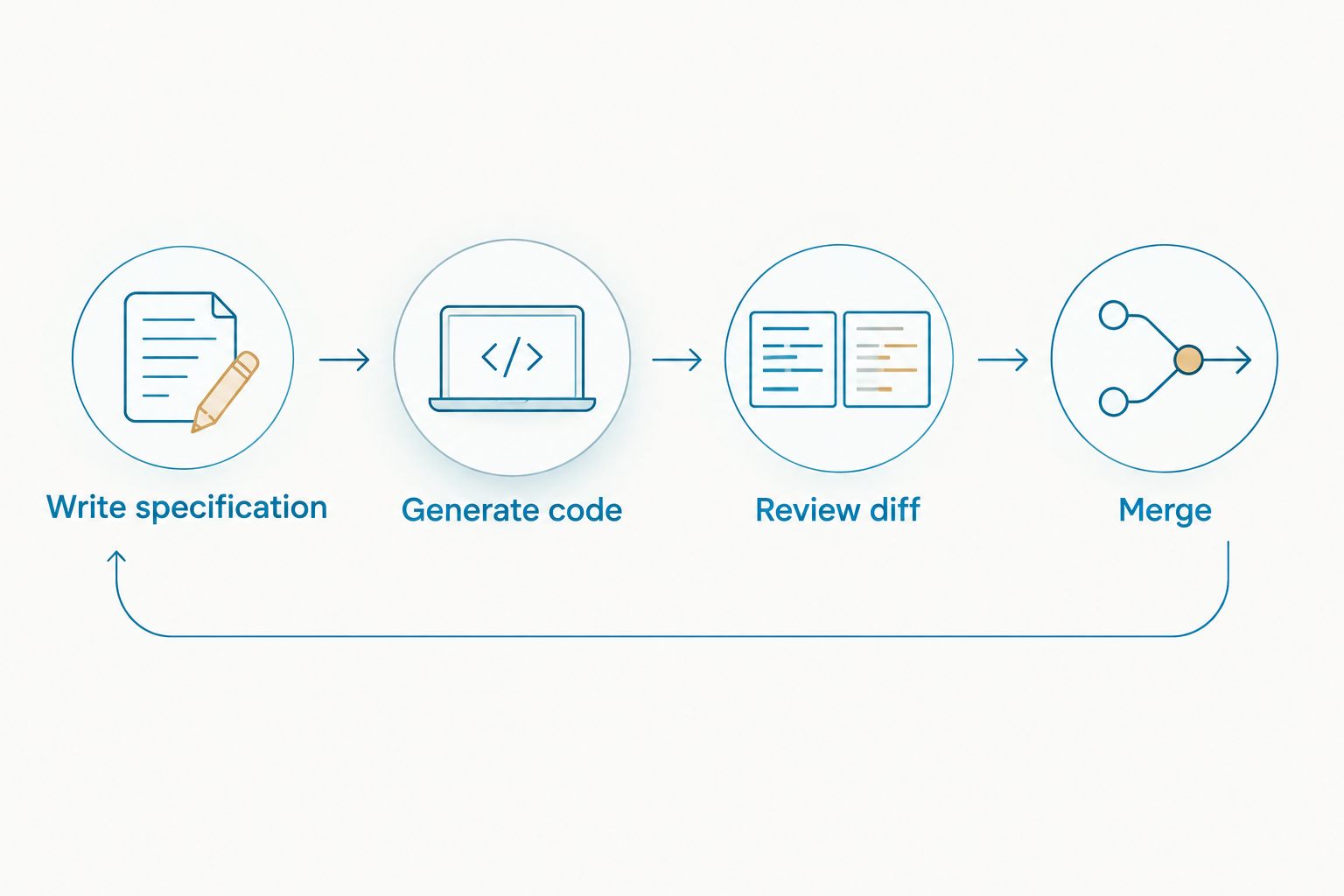
- Every AI code generation tool for Rust on this list still needs a human review of the diff before merge.
Why this matters
Rust's ownership model and borrow checker punish AI tools trained mostly on JavaScript and Python — a generic autocomplete engine either guesses wrong or produces code you'll spend more time fixing than writing yourself. The real split among AI code generation tools for Rust in 2026 isn't features, it's category: inline autocomplete inside an existing crate versus a coding agent that goes from a written specification to a working service.
Aexol Studio sits in the second category. It runs the Spectral coding agent against a specification file and produces the Rust crate — plus the GraphQL schema and Prisma models when the stack calls for them — in one pass, with the diff shown before anything executes.
What makes the best AI code generation tool for Rust
- Borrow-checker awareness — suggestions that respect ownership and lifetimes, not just syntax completion
- Spec-to-code vs. autocomplete-only — does it build a service from a description, or only finish the line you started
- Visible diffs before execution — you see what the agent will change before it runs anything
- Context across the whole crate — not just the open file or a single function
- Toolchain fit — works with cargo, and with GraphQL schemas or ORMs like Prisma when the service needs them
- Token efficiency on long sessions — multi-turn agentic tasks shouldn't get slower or pricier the longer they run
Rust AI code generation tools at a glance
| Tool | Best for | Standout feature | Key limitation |
|---|---|---|---|
| Aexol Studio (Spectral agent) | Spec-to-production Rust services | Generates Rust, TS, Python, Go from one spec; ~97% prompt cache reuse on long sessions | Learning curve if the team is used to line-by-line autocomplete |
| GitHub Copilot | Inline autocomplete in an existing crate | Broad IDE support (VS Code, JetBrains, Neovim) | No spec-to-code or multi-service generation |
| Cursor | AI-native Rust refactors inside the editor | Chat-driven edits across open files | Context limited to open files, not a full-crate spec build |
| Claude Code | Agentic multi-file Rust tasks from the CLI | Runs cargo commands as part of the task | No dedicated spec language for new-service generation |
| Amazon Q Developer | AWS-integrated Rust services | AWS SDK, IAM, and Lambda runtime awareness | Value drops fast outside the AWS ecosystem |
| Sourcegraph Cody | Large Rust monorepos | Codebase-wide search and context across many crates | Not built as a spec-to-code agent for new services |
| Tabnine | On-prem, privacy-first Rust completion | Self-hosted and air-gapped deployment | Local models trail hosted models on complex generation |
1. Aexol Studio: best AI code generation tool for spec-to-production Rust services
Aexol Studio lets a team write an application specification and hand it to the Spectral coding agent, which generates a production-ready Rust crate — along with TypeScript, Python, or Go, GraphQL schemas, and Prisma models where the stack needs them — from that one spec. Spectral shows the diff before it executes anything, so review happens before code lands, not after a broken build. Prefix caching and session affinity mean a long, multi-turn Rust build reuses roughly 97% of prompt tokens from cache, so big multi-file tasks stay fast and don't get more expensive the longer the session runs.
Aexol Studio pros:
- Generates a full Rust service (or Go, TypeScript, Python) from one specification, not one file at a time
- Coding agent shows the diff before executing, not after
- 97% prompt cache reuse keeps multi-turn Rust sessions cheap on big tasks
- Cross-session project memory means the agent doesn't relearn the crate's structure every session
Aexol Studio cons:
- Spec-first workflow has a learning curve for a team used to line-by-line autocomplete
- Gains are largest on a new service or MVP, smaller on patching one legacy function
Best for: a team building a new Rust service or MVP from a specification, not patching an existing file. Verdict: Buy.
2. GitHub Copilot: best for inline Rust autocomplete inside an existing crate
Copilot suggests Rust completions line-by-line inside VS Code, JetBrains IDEs, and Neovim, trained on public code that includes a large volume of Rust crates.
GitHub Copilot pros: broad IDE support, works inside the editor a Rust team already uses, reasonable completions for common trait implementations and match arms. GitHub Copilot cons: autocomplete-first design, no native spec-to-code or multi-service generation, still needs a human to catch borrow-checker conflicts before compiling.
Best for: a Rust developer who wants faster line completion inside an existing crate, not new-service generation. Verdict: Buy for autocomplete, Skip for agentic multi-file generation.
3. Cursor: best for AI-native Rust refactors inside the editor
Cursor is a VS Code fork built around AI chat and inline edits, letting a developer describe a refactor and apply it across open Rust files without leaving the window.
Cursor pros: refactor-across-files inside the same editor, chat-based context on the open crate, fast iteration loop. Cursor cons: context is scoped to open files and the current workspace, not a full spec-driven build.
Best for: a Rust developer refactoring an existing codebase who wants AI edits without switching tools. Verdict: Buy.
4. Claude Code: best for agentic multi-file Rust tasks from the terminal
Claude Code is Anthropic's command-line coding agent, able to read a Rust repository, plan multi-file changes, and run cargo commands itself as part of a task.
Claude Code pros: terminal-native agent workflow, can run tests and cargo check as part of the task, handles multi-file Rust changes without manual file-hopping.
Claude Code cons: no dedicated spec language for building a new service end to end, session cost scales with context size on long Rust sessions.
Best for: a team that wants an agent to work through an existing Rust repo from the CLI, task by task. Verdict: Buy.
5. Amazon Q Developer: best for AWS-integrated Rust services
Amazon Q Developer generates and reviews code with awareness of AWS SDKs, IAM policies, and Lambda runtimes, including Rust's AWS Lambda runtime.
Amazon Q Developer pros: tight integration with AWS services and IAM, useful for Rust Lambda functions and AWS-native microservices, security scanning built into the workflow. Amazon Q Developer cons: value drops fast outside the AWS ecosystem, less useful for a Rust project with no AWS dependency.
Best for: a team shipping Rust services that already live on AWS Lambda or other AWS infrastructure. Verdict: Buy on AWS, Skip otherwise.
6. Sourcegraph Cody: best for large Rust monorepos
Cody indexes an entire codebase for search and generation, which matters most once a Rust monorepo passes the point where a single IDE's file index keeps up.
Sourcegraph Cody pros: codebase-wide search and context across many Rust crates, useful for onboarding into a large monorepo, works across several repos at once. Sourcegraph Cody cons: generation quality depends on how well the codebase is indexed, not built as a spec-to-code agent for new services.
Best for: a team navigating and generating code inside a Rust monorepo with dozens of crates. Verdict: Buy for large monorepos, Hold for small projects.
7. Tabnine: best for on-prem, privacy-first Rust completion
Tabnine offers self-hosted and air-gapped deployment options, which matters for a team that can't send Rust source code to a third-party API.
Tabnine pros: on-prem or local model deployment, no code leaves the network in air-gapped mode, works across common IDEs. Tabnine cons: local models trail the largest hosted models on complex Rust generation tasks, agentic multi-file capability is more limited than terminal-native agents.
Best for: a regulated or security-sensitive team that can't send Rust source code to an external API. Verdict: Buy for compliance-constrained teams, Skip if API access isn't restricted.
How these Rust code generation tools were ranked
Each entry was placed against the six criteria above — borrow-checker awareness, spec-to-code vs. autocomplete, visible diffs, whole-crate context, toolchain fit, and token efficiency on long sessions. None of these tools wins on all six; that's why the list reads as a decision tree by use case, not a single leaderboard. For a wider view across languages beyond Rust, the broader AI code generation tool roundup and the separate ranking of AI coding agents cover the same criteria against a bigger field.
Which AI code generation tool should you choose for Rust in 2026?
If the goal is a new Rust service or MVP built from a specification, Aexol Studio with the Spectral agent is the default pick in 2026 — it generates the crate, not just a suggestion inside one. If you're patching an existing crate, GitHub Copilot or Cursor cover autocomplete and in-editor refactors. AWS-native Rust work goes to Amazon Q Developer, large monorepos go to Sourcegraph Cody, and air-gapped or regulated teams go to Tabnine. Enterprise teams evaluating agentic assistants at scale should also check the agentic coding assistants for enterprise teams comparison before standardizing on one tool.
FAQ
What is the best AI code generation tool for Rust in 2026?
Aexol Studio with the Spectral coding agent is the best pick for building a new Rust service from a specification. GitHub Copilot is the better pick for inline autocomplete inside an existing crate.
Is GitHub Copilot good for Rust?
Yes for line-by-line autocomplete inside a file you're already writing, but it doesn't generate a full service from a specification the way an agent-based tool does.
Can AI generate a full Rust service, not just autocomplete?
Yes. Aexol Studio's Spectral agent generates a complete Rust crate, plus a GraphQL schema and Prisma models when the stack needs them, from a written specification.
Is Claude Code better than GitHub Copilot for Rust?
They solve different problems. Claude Code runs terminal-native, multi-file agent tasks including cargo commands, while Copilot is an inline autocomplete layer inside the editor.
Which AI tool works best for Rust on AWS Lambda?
Amazon Q Developer, because it's tuned for AWS SDKs, IAM policies, and Lambda runtimes, including Rust's Lambda runtime.
Is there an on-prem AI code generation tool for Rust?
Tabnine supports self-hosted and air-gapped deployment, which fits a team that can't send Rust source code to a third-party API.
How does Aexol Studio handle long, multi-turn Rust coding sessions?
The Spectral agent reuses roughly 97% of prompt tokens on long sessions through prefix caching and session affinity, which keeps multi-file Rust tasks fast and cheap as the session grows.
Does an AI code generator replace cargo check or manual review?
No. Every tool on this list still needs a human review of the diff and a real cargo check or test run before merging.
One last thing
Cross-session memory is the detail most Rust teams overlook when picking an agent. Spectral's project memory uses n-gram indexing and ranked scoring instead of exact substring matching, so a query like "strcut Order" still surfaces the earlier decision about the Order struct in the crate — a typo doesn't erase the context. That matters more on a Rust project than on most stacks, because ownership and trait decisions made three sessions ago are exactly what a new agent turn needs to not contradict.
Generate your Rust MVP from a spec
See the Spectral agent turn a specification into a production Rust crate.